
Bidasar at a Glance

A quick snapshot of the town for those who have never visited — or haven't been back in a while.

Rajasthan
STATE
Churu
DISTRICT
Shekhawati
REGION
Hindi & Marwari
LANGUAGES SPOKEN
HERITAGE

Noteworthy Places & Monuments

Explore some of the places, monuments and landmarks that form an important part of Bidasar's heritage and identity.

From The Archives

Today's Bidasar

HISTORY & HERITAGE

Legends of Bidasar

The history of Bidasar is also shaped by individuals whose faith, character, service and influence left a lasting impression on the community.

01

Shobha Chandji Bengani (First)

V.S. 1840–1920

Shobha Chandji Baingani belonged to Bidasar and resided in the “New Pol” locality. Therefore, for identification, he and his family came to be known as the residents of the New Pol.

Shobha Chandji and his associates played a major role in bringing Terapanth into the Thali region. In this sense, he may be regarded not merely as an ordinary but as a highly dedicated श्रमण-कोटि श्रावक.

At that time, the influence of Yatis was widespread. Wherever there was a good Oswal population, temples or upashrayas were usually established for Yatis to live.Around V.S. 1885, due to certain dispute, a serious disagreement arose between the Bengani family and the Yatis. As a result, the family stopped visiting the Upashraya. The proud Yatis, attached to their knowledge and mantra-vidya, were unwilling to compromise, and instead of reconciliation, bitterness increased further.

Some businessmen from Bidasar who used to frequently travel to Pali for trade suggested inviting Terapanth religion to Bidasar as they believed that Terapanthi monks followed Jain religion in very dedicated manner and can be alternative against Yati’s arrogant behaviour. Hence prominent individuals such as Shobha Chandji, Uttam Chandji, Prithvi Rajji, and Panchanan Das ji Bengani travelled by camel caravans across long desert route to reached Pali where Rishi Rai was holding Chaturmas there. They prevailed upon Rishi Rai to visit Thali and this is considered start of Terapanth coming to Thali.
02

Uttam Chandji Bengani

V.S. 1860–1936

Uttam Chandji lived in the “Old Pol” area of Bidasar. He was among the four famous and foremost shravak of Bidasar who had gone to Pali and requested Acharya Rishi Raiji to settle at Thali. He was a simple and humble person with a deep understanding and influence in society. During his time he was regarded as an honourable and most respected member of the community.

He had immense devotion toward Jayacharya and would frequently remain present in their service who deeply respected his words and requests. Around V.S. 1932, the Acharya’s Chaturmas was held at Ladhnun. At that time he had some dispute with Thakur of Bidasar and he went to Ladnun. On completion of Chaturmas being a traveller, he requested the Acharya to again hold the next Chaturmas in Ladhnun so that he might continue serving him and does not need to return to Bidasar. It is said that the Chaturmas of V.S. 1933 and 1934 were held in Ladnun at Uttam Chandji’s request. Later, after reconciliation with the Thakur of Bidasar, when the Acharya returned to Bidasar, the Chaturmas of V.S. 1935 and 1936 were also organized there upon his request.Even at the time of his passing in V.S. 1936, he continued to receive the blessings of Aacharya’s.

03

Nag Rajji Bengani

V.S. 1880–1949

Nag Rajji Bengani was one of the renowned Jain lay followers of Bidasar. His father, Panchan Dasji, was among the first devotees who had gone to Pali in V.S. 1886 and requested Acharya Rishi Rayji to come to Thali. At his request, the Acharya first arrived in Thali and later spent the Chaturmas in Bidasar. At that time Nag Rajji was just seven years old. The seeds of religious values planted in his mind during childhood continued to grow, flourish, and bear fruit throughout his life.

He was a cultured and virtuous devotee. His noble conduct, sincere dealings, and natural simplicity made him distinct from others. He was as firm in self-respect as he was in religion and lived with dignity. Around V.S. 1930, due to some issue, he had a disagreement with Thakur Bahadur Singh of Bidasar. Under those circumstances, he felt it difficult to continue living there while preserving his self-respect. After consulting with relatives and friends, he immediately left Bidasar with his family and moved to Ladnun. In those days, for wealthy merchants to abandon their native town was considered socially humiliating and also caused financial loss to the village. The Thakur of Bidasar soon realized the seriousness of the matter, reached a compromise, and respectfully brought him back to Bidasar.

People held Naga Rajji in very high regard. He was considered an ideal example of purity and integrity in dealings. A popular belief spread among the public that even a piece of cloth used by him, if worn like an Tabeej, could cure illness, and childless people might be blessed with children. If by mistake any of his clothing was left outside, people would tear off small pieces from it.

It is said that Nag Rajji possessed divine intuition (shakti or spiritual insight). Through this ability he would often receive indications of future events well in advance. On Falgun Shukla 2, V.S. 1933, eighth Acharya Kalugani was born in Chhapar. At that time, standing before the Jaya Acharya during a open discourse, Nag Rajji declared that within a radius of four kos a great and influential Acharya of the Terapanth order had been born that very day.

Once, Acharya Maghawa Gani who was traveling from Mewar toward Thali. After departing from Boravad, he had severe problem of loose motion. During a stay of twenty days in Ladnun several treatments were attempted, but the illness did not subside. Around that time Nag Rajji Bengani received a strong inner feeling that the Acharya Shree should come to Bidasar to regain full health. Nag Rajji discussed the matter with Shobha Chandji Bengani and earnestly requested the Acharya to come to Bidasar. Maghawa Gani accepted the request and reached Bidasar on the Purnima of Ashadh to observe the Chaturmas of V.S. 1944 there. He regained his health at Bidasar.

04

Hanut Malji Bengani

An early figure of the Bengani family

Just as Shravak Shobha Chandji Bengani was religious-minded and devoted to the Jain order, his son Hanut Malji also possessed noble virtues, faith, and deep devotion toward religion. Once, while traveling to far off from Bidasar for business purposes, he passed by a Jain upashray during the morning hours. At that time, Ganeshji Yati who was in conflict and hostility with Hanut Malji came forward carrying a human skull in order to provide bad omen and curse him. The stench from the skull was so unbearable that all the accompanying companions had to cover their noses with cloth.

Hanut Malji however proceeded onward and reached a designated spot outside Bidasar with a peaceful mind. On reaching there, the munim traveling with him said “Seth jee, the Yati deliberately insulted and cursed you out of hostility and therefore today you should return home”. However Hanut Malji replied “If I return now, people will become fearful, and therefore I am going to Ladnun to have darshan of Kalugani Maharaj and get the opportunity to serve him for some time.” Later, when Hanut Malji’s wife learned of this incident, she sent their munim Deepchandji Bothra to Ladnun to bring Sethji back. When Seth Hanut Malji narrated the entire incident to the Acharya Kalugani Maharaj, the Acharya said: “One who truly practices spiritual austerity does not curse others. Therefore, there is no need for worry.”Hearing these reassuring words, Hanut Malji felt completely comforted. His faith in the Guru was so unwavering that no alternative thought remained in his mind. By the grace of the Guru, no misfortune occurred.

05

Paran Devi Bengani

A figure remembered for faith and generosity

Hanut Malji Bengani was as devout in religious matters and also generous in social matters. His wife Paran Devi (the sister of Samprat Ramji Dugar of Sardarshahar) was also an example of faith and generosity. Those who knew the couple closely often said that such a pair was rarely found.

Regarding the generosity of Shravika Parandevi, it is said that if anyone came to her home seeking expensive medicine, and even if the medicine was not available in the house, she would never refuse the visitor. Instead, she would seat the guest respectfully and send someone to the market from back side door to purchase the medicine. She could never tolerate a needy person leaving her home empty-handed even if she had to use buttermilk instead of milk at home.

As time passed, although their financial condition declined somewhat and they had to spend thousands of rupees beyond their means, their generosity never diminished. Their reputation for kindness and benevolence became widely known throughout the town.

06

Himmat Singh Ji Bengani

A historic figure remembered for bravery and sacrifice
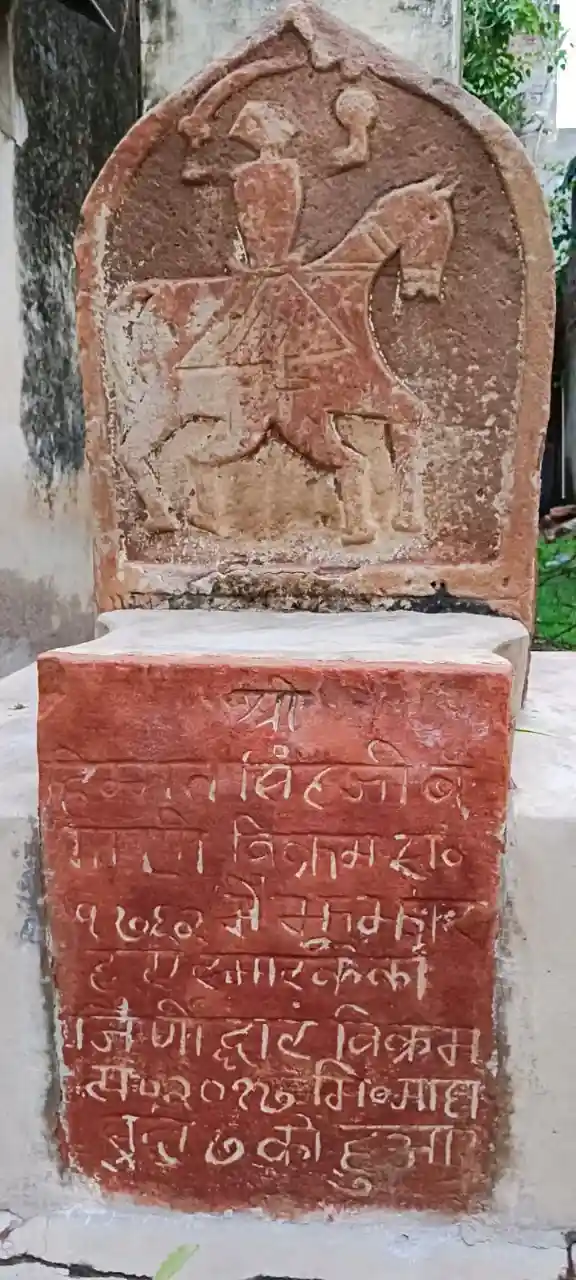
Memorial of Himmat Singh Ji Bengani

The town of Bidasar has established a distinct identity for itself throughout the country. According to its history, the town was established about 600 years ago. According to the ancestors, the Bengani community was among the earliest communities here, and the fort was also constructed around that time.

About 300 years ago, in order to protect the villages, Jhujhar Himmat Singh Ji Baingani demonstrated his bravery. In Vikram Samvat 1762, when robbers came to Bidasar to steal the village cattle, he fought them. During the battle, his head was severed from his body, but he continued fighting until his last breath, living up to the meaning of his name, and killed the robbers.

In his honour, the Thakur's of the fort built a memorial (smarak) alongside their own ancestors, an honour rarely extended to anyone. This memorial still stands today in the Akhada located in Mandi Bazaar.

There is an old saying associated with him:

“माया माणी बाधरा, माया माणी लागे फुलाणी, रही खड़ी माणाली, बीदासर रा बैंगाणी”
01

Known for

Painted havelis, beautifully decorated temples, and a long-standing tradition of trading families who settled across India. Bidasar is known for its distinctive Rajasthani architecture, rich cultural traditions, and strong sense of community.

02

Getting there

Bidasar is connected by road to major towns across the Churu and Sikar districts, with convenient routes from surrounding parts of Rajasthan. Rail access is available through nearby stations, making the town accessible for visitors travelling from different parts of the region.

COMMUNITY

Contribution To Society

Community initiatives and charitable institutions have played an important role in supporting the people and development of Bidasar.

01

Ram Temple

A place of faith and community, the Ram Temple reflects the religious and cultural traditions of Bidasar and the efforts made to preserve spaces that bring the community together.

02

GPT Sports Complex

The GPT sports complex provides a space for sporting activities and community events, encouraging participation in sports and creating opportunities for the younger generation.

03

JM Sethia Charitable Trust

The JM Sethia Charitable Trust has contributed to the welfare and development of the Bidasar community through charitable and social initiatives.

04

Jethmal Jiwraj Shekhani Charitable Trust

The Jethmal Jiwraj Shekhani Charitable Trust represents another important contribution to the welfare of Bidasar and its people through charitable and community-oriented work.

05

Medical Oxygen Plant

The medical oxygen plant is an important healthcare initiative supporting the availability of medical oxygen and strengthening healthcare infrastructure for the local community.